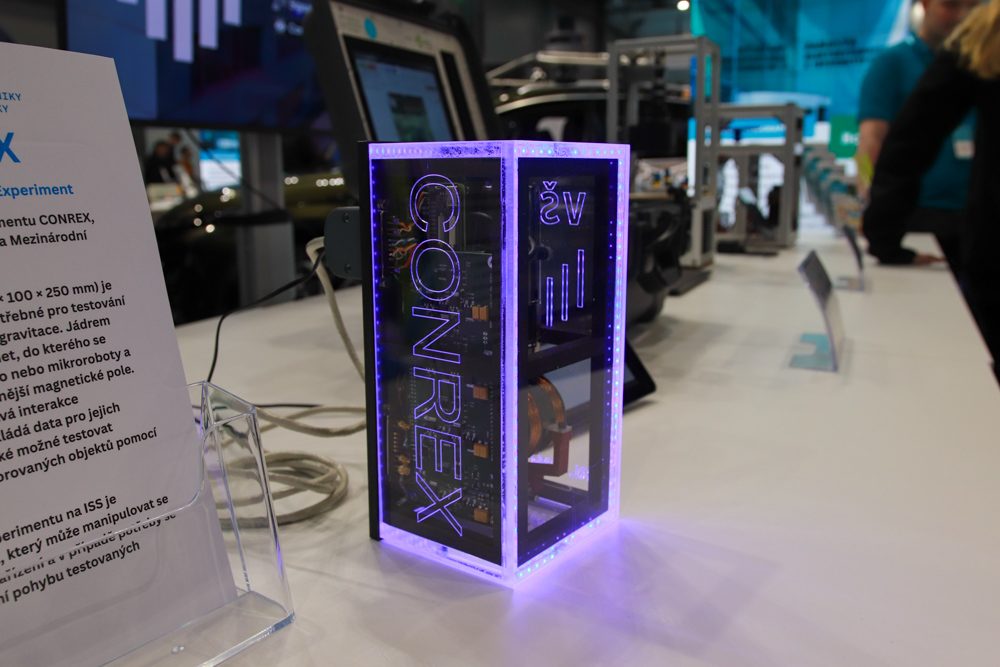
Brno/Ostrava, 17 March 2026 – The Czech nanorobotic experiment CONREX, aimed at suppressing resistant bacteria using nanotechnology, has successfully completed its initial phase. Following the signing of a contract with the European Space Agency (ESA), the team from VSB – Technical University of Ostrava and the company TRL Space is now starting work on a detailed engineering design. This will determine the final form of the laboratory module that will accompany astronaut Aleš Svoboda to the International Space Station (ISS). Compared to the original schedule, development is progressing faster than expected.
Nanorobots: Disruptors of Biofilms
The CONREX project (Czech Orbital Nanorobotic Experiment) is a unique experiment focused on testing magnetically controlled nanorobots in microgravity. Its main goal is to disrupt so-called biofilms – complex structures that significantly increase bacterial resistance to antibiotics and disinfectants. In healthcare, biofilms often form on orthopedic implants, heart valve replacements and other medical devices, where they can cause infections.
“In CONREX we focus on both the chemical and physical aspects of the problem. Our nanorobots act like a sophisticated ‘high-tech scrubber’. Under the influence of a magnetic field, they collide with the biofilm and mechanically ‘scrub’ it while chemically destroying it. This breaks down the structure, kills the bacteria and ultimately eliminates the infection,” explains Prof. Martin Pumera, head of the Advanced Nanorobots & Multiscale Robotics Laboratory at the Faculty of Electrical Engineering and Computer Science at VSB – Technical University of Ostrava.
However, biofilms are not only a risk for patients. They also occur in water distribution systems and air-conditioning infrastructure, where they can serve as reservoirs of pathogenic microorganisms. Studying these processes on Earth is limited by gravity, which causes particles to settle and affects fluid flow.
“On the ISS we will obtain data on the movement of nanorobots in a fully three-dimensional space. Without the influence of Earth’s gravity, we will be able for the first time in history to precisely measure their efficiency and collision dynamics with bacteria in a purely physical environment,” adds Pumera.
An Autonomous Laboratory in Orbit
A key role in this phase is played by the company TRL Space, which is developing the experimental module. In orbit, the module will generate an electromagnetic field, control the movement of the nanorobots and monitor their behaviour using an integrated digital microscope. The module will therefore function as a small autonomous laboratory, allowing the experiment to run without direct human intervention.
“After signing the contract with ESA, we moved from the theoretical concept to a detailed engineering design. We are defining the final technical parameters of the device so that it meets the strict safety standards required for integration into ISS systems. Development is currently progressing faster than we originally expected,” says Petr Kapoun, CEO of TRL Space.
The Faculty of Electrical Engineering and Computer Science at VSB – TUO is also contributing to the technical and systems aspects of the project. The research team previously demonstrated that magnetic microrobots can effectively disrupt E. coli biofilms under laboratory conditions and optimized both their synthesis and control.
“The CONREX project builds on these results and expands them into the microgravity environment for the first time. Our goal is to create an autonomous system capable of controlling nanorobots in this environment without direct human intervention. At our faculty we have a unique environment where electrical engineering, computer science, artificial intelligence and advanced control methods naturally intersect. This interdisciplinary connection enables us to address such a complex challenge – from designing electronics and control systems, through data processing, to the development of autonomous algorithms. Experts from multiple departments are involved in the project, and we also use specialized laboratories for testing and development of individual system components,” says Prof. Radek Martinek, Dean of the Faculty of Electrical Engineering and Computer Science at VSB – TUO and principal investigator of the project.
CONREX on Its Way to Space
The CONREX project connects cutting-edge academic research with the Czech space industry and is one of the experiments within the national program Czech Journey to Space, being prepared for the mission of astronaut Aleš Svoboda to the International Space Station (ISS).
“One of the main tasks of an astronaut on the ISS is to work with scientific experiments. CONREX is a great example of how microgravity can help test technologies that simply cannot be properly tested on Earth. Projects like this give space missions real meaning because they bring new knowledge and technologies that can be applied here on Earth,” concludes Major Aleš Svoboda, future Czech astronaut.