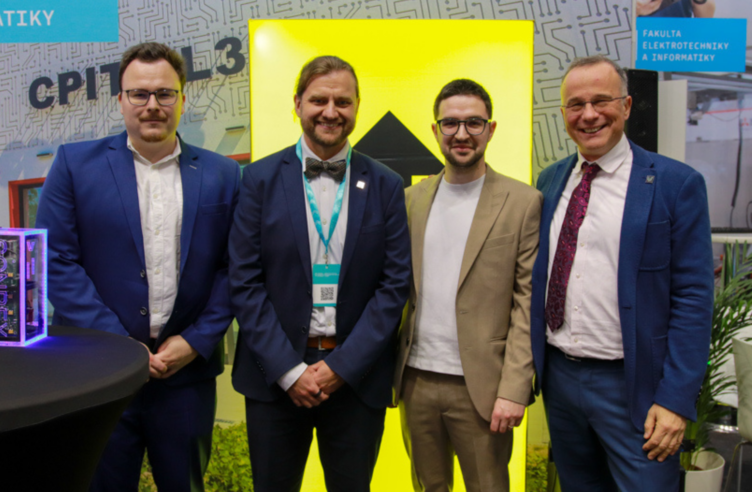
Brno, 17 June 2026 – Technologies for space missions are already being designed and manufactured in the Czech Republic. Testing them, however, is still something many companies often have to arrange abroad. Brno-based TRL Space wants to bring this part of development closer to Czech companies, startups and research teams. In cooperation with JD Dvořák, a renowned supplier of testing and measurement equipment and a specialist in environmental simulation, material testing and microscopic analysis, TRL Space is opening a new centre worth nearly CZK 20 million. The facility will make it possible to test how technologies perform under vibration, shock, vacuum and significant temperature changes. The centre will serve TRL Space’s own space projects as well as technology partners from a range of industries.
Testing is one of the most important stages in the development of space technologies and many other advanced systems. Before final deployment, it is essential to verify whether a device can withstand all the conditions it is designed for, whether that means a rocket launch, transport or operation in space. Similar tests are also important in other industries, including defence, automotive, energy, electronics and the development of industrial prototypes. “In the space industry, it is not enough to design a technology based only on theoretical calculations. You need to physically test it as early as possible in conditions that are as close as possible to real operation. That is why we are opening our own testing capacity directly in Brno. We want to shorten the path from design to a verified solution, not only for our own missions, but also for other companies and partners,” says Petr Kapoun, CEO of TRL Space. He adds: “Similar centres exist both in the Czech Republic and abroad. When selecting the vibration and thermal vacuum technologies, however, we looked for the optimal size and performance so that we could offer highly competitive prices as well as expert additional services.”
Vibration and vacuum testing: verifying whether technologies can withstand demanding conditions
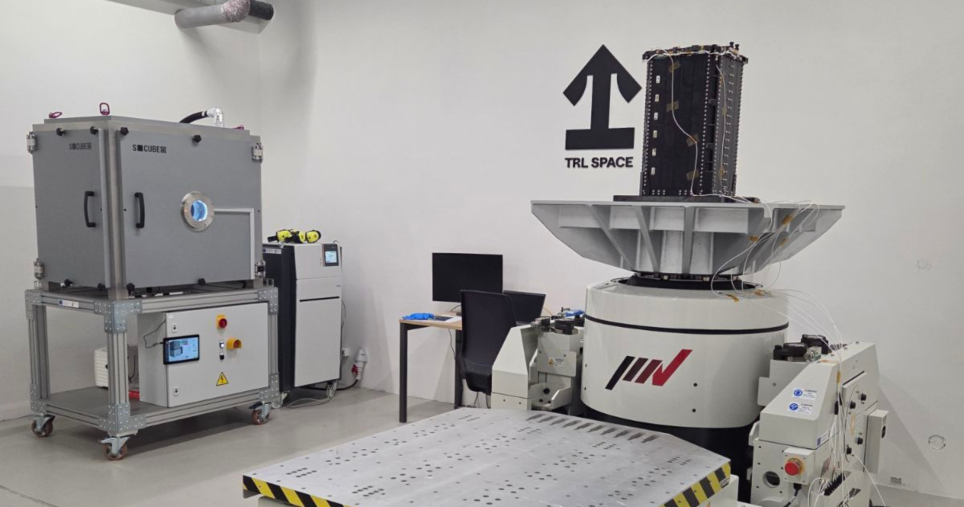
The centre is equipped with two main technologies: an IMV A45/EM4HAG electrodynamic vibration system including an RT1050 slip table and a Centrotecnica head expander, and a TVAC S-CUBE 94203 thermal vacuum chamber. The vibration system makes it possible to test how equipment withstands mechanical stress, vibration and shock. When a car drives over potholes, a drone faces strong vibration during flight or a satellite is launched into space on a rocket, the electronics inside must work flawlessly. This is why vibration tests are used to simulate mechanical stress. In the automotive industry, they are used to verify the reliability of batteries, sensors and control systems. In the defence industry, they help test, for example, the electronics of unmanned systems, radars and communication technologies. “Over more than thirty years of our company’s operation, we have seen that thorough testing is often what decides whether a product succeeds or fails in real operation. Whether it is automotive electronics, defence technologies or satellite systems, the goal is always the same: to identify potential weaknesses before they appear in practice. I am pleased that we are building on our previous successful cooperation with TRL Space by opening this centre,” says Tomáš Dvořák, CEO of JD Dvořák.
The second key technology in the centre is a thermal vacuum chamber from the Czech company STREICHER Plzeň. It makes it possible to simulate extreme temperatures and low-pressure environments. It can be used to test satellite components, aerospace electronics and equipment designed for demanding climate conditions. The goal is to ensure that technologies work reliably not only in the laboratory, but also in some of the most demanding real-world conditions.
The selected chamber also offers a practical layout and efficiently usable internal space, allowing it to adapt more easily to different types of tested devices. It can therefore be used not only for satellite components, but also for electronics, optical systems, materials and industrial prototypes. “The thermal vacuum chamber makes it possible to simulate the space environment, from deep vacuum to the extreme temperature differences experienced, for example, by satellites in orbit. The same principles are also used in the development of semiconductor technologies, optical systems, aerospace electronics and defence applications. The new testing facility is intended for testing small satellites and their components in order to verify their behaviour according to international standards,” says Emil Černý, Sales and Technical Director at STREICHER Plzeň.
Everything in one place: from design to verified hardware
The advantage of the new centre is not only the availability of new testing capacity in the Czech Republic, but also its connection to TRL Space’s wider facilities. These include a clean room for integration, an electronics laboratory equipped, for example, with a Rohde & Schwarz MXO 3 oscilloscope, a 3D printer farm for printing with standard materials as well as the unique Prusament PC Space Grade Black, and a mission control room. In the coming months, a clean room will also be built around both pieces of equipment in the testing centre. This will make it possible to design, prepare, integrate and test technologies in one building. For startups, research teams and technology companies, this can significantly simplify development, as testing is often one of the most demanding parts of the entire process.
Zaitra will be among the first users; the centre will also support the CONREX project
One of the first users of the new testing centre will be Zaitra, which will use it in the development of SKAIDOCK, its onboard data processing unit for small satellite missions, where testing reliability in the space environment is essential.
In the future, the centre will also support other TRL Space projects. One example is the CONREX experiment, prepared in cooperation with VSB – Technical University of Ostrava for the planned mission of Czech astronaut Aleš Svoboda to the International Space Station.
About TRL Space
TRL Space is a Brno-based company delivering complete turnkey space missions, from initial design and launch into orbit to satellite data analysis. It cooperates with the European Space Agency and global players, brings together leading scientists, engineers and visionaries from around the world, and develops its own technologies designed not only for orbit, but also for the Moon. Its missions share one ambition: to push the boundaries of what is possible. TRL Space is part of the TRL Group, a dynamic group of technology companies delivering advanced technologies worldwide.
About JD Dvořák
JD Dvořák provides full-service solutions in the testing and measurement of materials, components and complete products. The company supplies testing and measurement technologies for environmental simulation, material testing and microscopy. For each customer, it looks for the most suitable solution, whether that means a new device from its standard product portfolio, a customised solution or a fully special made-to-order system. Through its own accredited testing laboratory, the company offers sample testing as well as possible equipment rental. Its JD Academy educational project provides methodological seminars focused mainly on practical experience in testing, measurement and metrology.